by Jacob Ninan

Introduction
Christianity is not primarily about philosophies or doctrines, or a set of religious rituals, but a relationship with God that will affect every part of the way we live our daily life, moment by moment. The whole reason why Jesus took the form of a Man, came into this world and died on the cross was to give us a real, practical form of an abundant life (Jn.10:10). It defines our goal in life, the choices we make, the attitudes we keep, the words we speak and the things we do. But it is not automatic that after we come to Jesus in the first place, that everything in our life just turns out fine! It takes us time to understand the ways of God, submit to Him and make changes from our old ways. We still have our old, sinful desires in us, and they keep troubling us till we learn to overcome them.Another thing that happens is that our understanding of the word of God is mixed up by the many wrong ideas that are floating around. Think about one example. What do you understand by faith? Is it a belief, a feeling, an assumption, or a set of ideas which you agree with? There are many teachings that lie between working up our faith on one side to leaving things entirely to God on the other end. How do you know your faith is genuine? By the feelings it produces, or because that is what your parents or pastor taught, or is it something that comes up in your heart as a relationship as you get to know God? Faith is just one example where people have different ideas and assume that their faith is right. But think about it. If what we consider as faith is wrong, we may not even have true salvation, but we may imagine so, and then we are really in a very dangerous position.
A lot has to do with how we choose to believe certain things and reject other ideas. Some people just act according to how they feel in the moment, and everyone knows how dangerous this can be. Some feel pressurised by the situation, and they believe they have no other option but to act out in a certain way. Sometimes we put the blame for our actions on others who said or did something which provoked us, and say that what we did was because of what the others did. But aren't we responsible for what we do, irrespective of what others have done? Think of it. Let me repeat it. Aren't we responsible for what we do from our side, irrespective of what others have done? In this context, I think it will be helpful for us to understand the process by which we make decisions, so that we can control the process from our side, and in that way guide the decisions we make.
How our mind works
As we know, we are beings who have a physical body, a mind (soul - psuche in the New Testament Greek, from which comes the word psychology which is the study of the mind) and we have our human spirit. That is how the Bible describes us (1Th.5:23). Even though some people use the word soul to refer to our mind and also to the human spirit, strictly speaking, we should make a distinction between the two, and use it to refer to our mind. If we mix up our mind and our spirit, it will lead us to some confusion. For example, one reason why some Christians do not like psychology is because they believe that our spirit and mind belong to the realm of our relationship with God, and that the word of God is sufficient to deal with that.Scientists learn about our mind by observing many different people, forming theories about how the mind works, and then validating those theories using experiments wherever possible. But since our mind is somewhat abstract and not material in nature, psychology is not as exact as some of the natural sciences which deal with material things. Another part of our being, our spirit, is again something we cannot actually describe physically, and so it is natural that there is some confusion about the nature of our mind and the spirit. Something that disturbs some Christians about psychology is that secular psychologists do not generally consider God and our relationship with Him as a part of the discussion, and this obviously excludes many factors from consideration. For example, secular psychologists generally treat spiritual problems also as merely natural issues. Also, sometimes the suggestions some psychologists make may even be against the values revealed by God in the Bible. As a result of such mixture and confusion, some Christians take the position that psychology is to be rejected as being outside of God's truth. But, as they say in English, that will be like throwing the baby also out along with the bath water! No. Psychology does give us a lot of understanding about how our mind works, how things can go wrong, and what we can do to deal with mental problems. If we keep our knowledge of God as our baseline, and the Bible as the source of spiritual truths, we can then see that we can accept from psychology what is in line with the principles and teachings of the Bible.
To understand how our mind works, in a simple manner, we must understand that there are three basic functions in our mind. The first function is to think rationally, interpret the inputs, recall from memory, analyse the situations looking at the pros and cons, and then to understand what we need to do. The second function is to feel emotions about what we are experiencing. The third function is to commit to a decision to take action. Psychologists refer to these as the rational part, the emotional part, and the volitional part.
Without getting into complex theories, let us see how things work. When we receive an input from the outside world, our brain interprets it and informs the two parts of our brain that deal with the rational function and the emotional function. The emotional part reacts instantaneously to the situation and produces feelings in us. God has designed it like this as to provide us a signal that catches our attention and prompts us to take action. This is very useful in case of emergencies where we have to act immediately. These feelings are based on what is already in our memory about such situations, based on what we have experienced or known before. The rational part, on the other hand, thinks about it, and decides what is to be done about it. It takes time to think about the pros and cons, including the possible consequences of the action which our feelings prompt us to take, and come to 'considered' conclusions. Many times, this rational part may have to overrule the emotional part, considering the different factors. Then when we have come to a decision, we carry it out by exercising our volition, or will. Finally it is our body that carries it out.
A common mistake
A problem comes if we don't wait for our rational part but go ahead to do something based on our feelings. Feelings are almost instantaneous, and they have not had the time to listen to the outcome from the rational part. If we listen to the negative feelings which are roused up by the situation, and allow them to take control, that is what will happen. Our feelings will take control, and then things can spiral out of control. Psychologists say that if we lose our control over our feelings, we go 'temporarily mad'! We will end up saying or doing things which we will regret later. We ourselves will wonder why we did or said those things which we would never have done normally. We must also realise that evil spirits are hovering near us to tempt us. When they see that we are losing control, they will slip in ideas into our mind suggesting further negative actions. Suddenly we think, "Give him a slap. Tell him what you think about him. Enough of this, walk out of this relationship. There is no hope, go hang yourself. Just resign and walk out, etc." We may not realise that these ideas are from evil spirits, but assume that they are our own thoughts. So, we can see that giving in to what we feel at the moment can be very dangerous and can lead to very drastic results.But just think, there may be details here in our situation that we have not looked at, or we may be unfamiliar with the present situation, etc. We may have misread the situation, we may have misunderstood the other person's motives, we may not have thought about possible consequences, we may be judging someone too impulsively, we may be forgetting about our own mistakes, etc. Then that situation requires our further thinking before we can make our decision. If we think about factors like these, we may be able to connect various other factors also into the situation, and we may be able to make a much better decision than by relying on our feelings. Now we can see how dangerous it can be to rely entirely on our immediate feelings and make decisions.
Understanding negative emotions
Let us look at some common negative feelings to see how they work. We are looking specifically at negative feelings because these are the feelings that come up in difficult situations, and where we have a greater tendency to make mistakes. Psychologists have grouped negative feelings into three families, so that it becomes easier for us to deal with them. These three families of negative feelings are resentment, anxiety and guilt. Resentment, anxiety and guilt.Resentment includes feelings like anger, rage, unforgiveness, grudges, malice, wanting to take revenge or to teach someone a lesson, etc. We feel angry when our goal, or what we desire, is blocked, by someone, some situation or even God! We want to do something, or we want something to happen. Then when something comes and stands in the way of our goal, we become angry. Our feeling tells us to respond in anger. But the Bible tells us to be careful not to sin when we get angry (Eph.4:26,27). (This verse shows us that anger itself is not a sin, and, for that matter, feelings are not sin, but we must be careful not to sin when we become angry.) In order to manage things, we need to make use of our rational part of our mind also. That will remind us about what God wants, and help us to think more deeply about what really happened, how serious it is, how we can forgive others and be merciful to them, in what way to respond, what the consequences will be if we do wrong, etc. This will bring about a better result than if we had just acted out on our feelings.
Anxiety comes when the future is uncertain. We don't know what will actually happen, and so we don't know what we can do if something happens. The other members of this family are worry, confusion, tension, stress, fear, panic, etc. If we listen to anxiety enough, it will create in our mind all kinds of fearful possibilities, and it will take us towards panic, impulsive actions, hopelessness, desperation or giving up. We know that the answer to anxiety is in knowing that God is with us, and that He will handle all things for us, if we let Him. So the Bible tells us to share all our care deliberately to Him and then believe that He will tell us what to do (1Pet.5:7).
The third family of negative feelings is guilt. There are two types of guilt. One is what we feel when we realise that we have done something wrong. This is normal, and the right way to deal with it is to confess our sins to God and to the people we have sinned against, and receive forgiveness. Many people suppress their feeling of guilt and harden their conscience, and some others nurture their guilt till they become hopeless. The other form of guilt is what we feel when we cannot meet our own expectations. This happens when we set up unreasonable, unrealistic or unreachable goals for ourselves, and we can't reach them. For example, wanting to do something in the best way possible is a good desire, but to get disappointed when we cannot be perfect gives us guilt. If we don't understand this, when we make a mistake and especially when others make some comments about our mistake we feel very small! In history, there have even been instances where brilliant people have committed suicide when they could not tolerate some mistake on their part! The solution is to accept our practical limitations, remembering that we are not God, but only created beings with all kinds of limitations. When God has accepted us, we ought to accept ourselves too.
Temptations
Temptations are ideas that come up in our mind which invite us to take some action which we know to be wrong, in order to get some pleasure or personal gain. Since we all carry inside us our old sinful nature, we are always vulnerable to sinful desires coming up in our mind (Jas.1:14,15). Sometimes Satan (or usually one of his demons) makes use of the presence of these desires within us and tempts us to follow them in different situations. In addition, we are tempted to do some things wrong in order to enjoy the pleasures which the world offers us. When these temptations come into our mind, they produce in us some anticipation of the pleasures that are waiting for us if we yield to the temptation. If we start imagining about it, we can get excited in our feelings. We may also get other feelings at the same time along with this excitement, such as guilt knowing that what we are thinking of doing is sinful, or fear that we could get hurt in some way. But we sin if we allow this excitement to build up and allow warnings and questions in our mind to be overpowered.Our goal
Overcoming feelings
Now we can see that if we allow these feelings to rule in our mind, without thinking rationally about the situation and coming to appropriate decisions, they will ruin our life. The Bible tells us to be renewed in our mind as the means of being transformed into the divine nature (Rom.12:1,2). This means that as we soak into the word of God more and more, our understanding will change, our values will change, and our attitudes towards God, people and ourselves will change. When we follow our new understanding into our practical life, our behaviour also will begin to be transformed to become more and more like Jesus. Mere knowledge is not enough. On the contrary, if we act based on our immediate feelings, not only will we end up doing fleshly things, but our sanctification will also get sidetracked. Now let us look at how we can overcome our feelings.
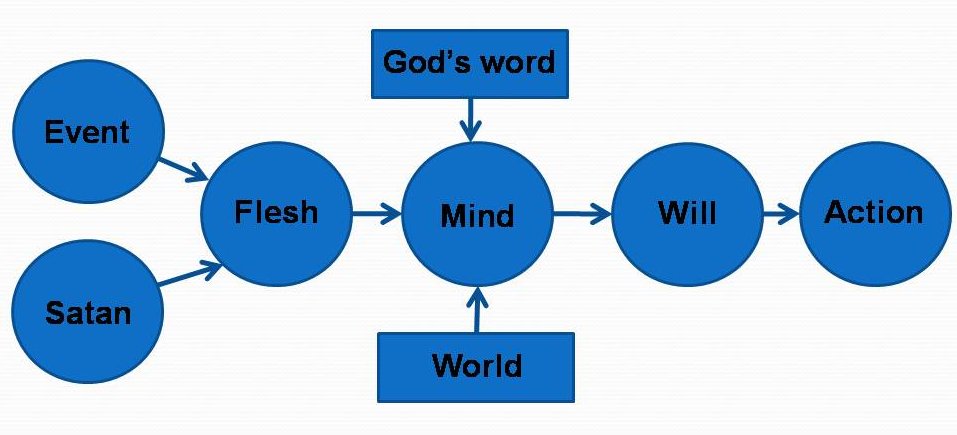
We can see in this diagram how our desires come into our mind when they are stimulated in our flesh through situations that we are going through, and as temptations come from Satan or worldly attractions, and how it is in our mind that we make the choice that will result in our action. The word of God gives us the standard for our life, and our aim must be to follow it, after denying ourselves from doing what we feel like doing. When our feelings are getting stimulated, and we are getting excited to do something immediately, we ought to pause and think in order to make a decision or choice.
You may have noticed in your life, that many times when temptations come, they come with a sense of urgency and pressure, as if to tell us that we should do something quickly, or we may lose something. But if we allow our feelings to get excited, it becomes more difficult for us after that to deny ourselves and do the right thing. It shows us that if we are to overcome our feelings, we must do it before allowing them to get excited. If we wait and continue in our negative feelings, the chances are that we might cross our level of tolerance and lose control.
Think of negative feelings as signals God gives to tell us that something is wrong, and that we need to do something about it. If it is an emergency situation, we must act immediately when we get this signal. But, after we understand the signal, if we keep nurturing the feelings, they have a tendency to grow stronger, fast. If that goes on, we can lose our control and act out impetuously! We become, as we said before, temporarily mad! What are some examples of what happens if we dwell on the feelings?
Let us say a husband and wife are having a discussion. Let us say the subject is not really a serious issue between them. But then one of them uses a particular word, or does something, which triggers the other person who then loses control. Then the communication gets heated up, and this person threatens to walk out of the marriage! Feelings have gone totally out of control!
One man has forgiven another one who had hurt him seriously some time earlier. But when a thought about the other man comes up, his feelings of hurt resurface, and he starts thinking of the things that have gone on between the two of them, and each memory is adding fuel to the fire. He now wonders what his forgiveness meant, after all. He may now decide to take some action against the other man.
Whether the feeling is anger, anxiety or guilt, or even in the case of physical desires like for food, drink or sex, the way to overcome is by switching from the domain of feelings to the rational part of our mind. That is where we think of what the Bible says about the subject, what we feel like doing, what kind of consequences can take place, etc., and then we can come to make the right decision. So, what we need to do is to recognise when we tend to be taken over by feelings, and then to make a conscious switch to rational thinking. The first thing we must do when we realise that our feelings are rising is to make a 'pause'. This could be taking a deep breath, making sure that our mouth remains shut, or in the worst case, walking out of that room, in order to prevent an immediate, un-thought-out reaction from our side. The second thing is to deliberately change our thoughts to another subject till we are calm again. This is the step that moves our focus from feelings to rational thinking. This is where we, If we find ourselves to be too weak to make this switch, have to cry out to the Holy Spirit for help.
For example, when thoughts of the harm that someone has done to us comes up, we switch to our rational thinking and remind ourselves that we have already forgiven that person. Then we decide to think of other matters and give no place for going over our past experiences and reliving our feelings of hurt! A cow is known to swallow some food in a hurry, and then later to bring up the unchewed food back into the mouth to chew properly (or chewing the cud)! We do not have to imitate this! Why should we hurt ourselves again and again by going through the old memories?
You may have noticed that if we get angry and remain angry, we start getting ideas in our head about how to outshout the other person, show him who we really are and teach him a lesson, take things to the next level so that he will fear to come at us again, etc. Have you thought where these thoughts are coming from? They could be from what you have observed in other people, what you have seen in movies, etc. But they could also be from evil spirits who want you to do harm to the other person and ruin yourself also in the end (Eph.4:26,27 NIV). Can you see how dangerous it can be to continue in your negative feelings, and how important it is for you to calm down and start thinking of the matter in an objective manner?
An example
When I started driving a car, there was a street near our house through which I had to go often. This was a long straight two way street without any median, and there were several cross roads on both sides. This led to chaos, with motorists and pedestrians going in both directions and also crossing the road without any show of signals or patience, but each one intent on getting to his place fast. This made me furious, experiencing the lawlessness, disorder and unpredictable obstructions. I wanted to shout at them or even stop the car and correct them. But I felt helpless! Later on, as I thought about it, I realised that there was nothing I could do from my side that could change these people's behaviour! I also understood that for my own peace of mind it was better for me to come to terms with the situation. Then suddenly I saw the situation as being hilarious or comical, and could imagine how a cartoonist would have pictured it. That changed my whole approach. From then onwards, when I noticed myself getting worked up in similar situations, I could switch my thoughts to look at the humour there. That took care of my fury!When anxiety starts to creep into our mind, what may happen is that we think over the things that can happen in the future, and begin to feel helpless about them. More and more negative possibilities come up in our mind, and we may get into panic or lose hope entirely. But as Christians we know that God is with us and He will take care of us. But at that moment of anxiety, God seems to be far away. The trick is to switch from the domain of feelings to rational thinking. Then we can assert to ourselves that God has promised, His promises cannot fail, He has taken care of us in many situations in the past, etc. If we are able to make this switch, we will find that our feelings also calm down.
This brings us to another practical aspect of dealing with feelings. When we are right in the middle of a challenging situation which we have not faced before, there are no resources in our memory to help us. The chances then are that we might make a mistake in our response. But we can then learn from our mistake, think over what happened with the help of the word of God and the Holy Spirit, and then we will be better prepared for the next time. This is spiritual growth.
Let us break that down into two stages, the online stage and the offline stage! The online stage is where we are right in the middle of the provoking situation. Our limited goal in this stage is only to make sure that we do not let ourselves go out of control. In other words, our goal is to prevent us from doing or saying any wrong thing. So how we do that is by keeping quiet, taking deep breaths, walking out of the room, etc. Then comes the offline stage later where we are alone and away from the provocation, when we can start thinking over what happened, what God thinks about it, what we could have done, how to understand the other person, what we should do now to set things right (ask for forgiveness, if necessary), etc. This stage is what will help us to grow, and become able to handle things better next time.
Some common challenges
Certain types of experiences such as having grown up under too much of control or abuse in childhood have caused certain people to develop a subservient, fearful, timid approach. One result of this could be that their ability to make decisions for themselves may have been weakened. They may need help from counsellors to regain control of their will. Another challenge which some Christians face is that they have been taught to expect God to do everything for them. Such people, for example, ask God to give them patience, take away their anger, anxiety, lust, etc., without realising that it is their responsibility to work out their salvation using the help God gives them (Php.2:12,13). This problem sometimes is so deep that even when such people go for counselling, they expect counsellors to change them, and they themselves do not know how to change their own understanding and adopt new practices.Conclusion
We are to be overcomers. One famous Christian teacher called A. W. Tozer once wrote, "Every man is as holy as he really wants to be!" God offers us salvation, but how much salvation we receive depends on how earnestly we seek it. We need to sit up and start taking responsibility for our life. Of course, we need help from God and also from other people. But primarily, we are the ones who are responsible for receiving the salvation which God has prepared for us.